


Challenges Facing IT Leaders
- Severe knowledge loss due to retirements and contractor attrition
- Thousands to millions of lines of undocumented code with complex, unmapped dependencies across legacy environments
- Security, compliance, and quality risks that are difficult to quantify
- High modernization risk without understanding system interdependencies
- Pressure to stabilize now due to limited budget, tight timelines, and ongoing risk and cost exposure
3-PHASE APPROACH
EVALUATION
Know what you have and your options before you act
- Rapid assessment of legacy applications and code
- Visibility into security, quality, and architectural risk
- Clear view of system dependencies
- (Completed in ~30 days)
STABILIZATION
Reduce risk, regain control, and extend system life
- Map dependencies to support safe changes
- Enable impact analysis before updates are deployed
- Improve stability while reducing reliance on scarce legacy expertise
MODERNIZATION
Explore new systems or migrate with confidence
- Identify modernization paths based on real system behavior
- Support refactoring, cloud readiness, or selective migration
- Establish ongoing insight and governance for future change
Why This Matters
- Avoid costly modernization failures
- Extend platform life while planning future transitions
- Reduce dependency on scarce legacy system expertise
- Improve security, compliance, and audit readiness
- Enable smoother vendor and code ownership transitions
Contact Alivia Today!
Please fill out the form below. No pressure, just a productive discussion with one of our solution experts.
Frequently Asked Questions (FAQ)
What is legacy system modernization in healthcare?
Legacy system modernization in healthcare refers to upgrading or transforming outdated software platforms, such as COBOL, RPG, Java, or .NET systems, into more secure, scalable, and maintainable environments. This enables healthcare payers to improve compliance, reduce operational risk, and integrate with modern technologies like cloud, APIs, and analytics.
Why are legacy systems a risk for healthcare payers?
Legacy systems often lack documentation, visibility, and modern security controls. This creates challenges such as:
- Increased risk of system failures
- Difficulty implementing changes safely
- Compliance and cybersecurity exposure
- Dependence on retiring or scarce expertise
Without proper insight, even small updates can cause major downstream disruptions.
What is LegacyIQ™ software and how does it work?
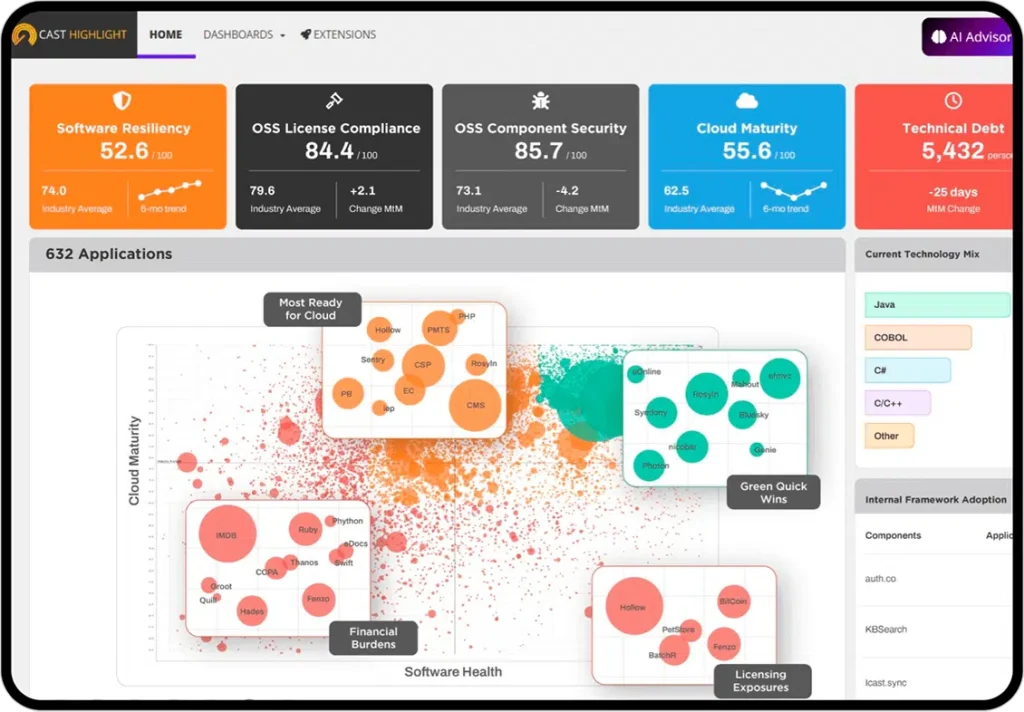
LegacyIQ™ is a software intelligence platform that automatically analyzes application source code to provide deep insights into architecture, dependencies, security risks, and code quality. It reverse-engineers applications to create a complete, accurate map of how systems function, without relying on outdated documentation or tribal knowledge.
What technologies does LegacyIQ™ support?
LegacyIQ™ supports 150+ technologies across legacy and modern environments, making it ideal for complex enterprise systems.
Key supported technologies include:
- Mainframe & Legacy: COBOL, JCL, IMS, CICS, IBM z/OS, RPG (AS/400)
- Modern Languages: Java, C#, Python, Go, C/C++
- Microsoft Stack: .NET, ASP.NET, VB.NET
- Web Technologies: HTML, CSS, JavaScript, Angular, React, Node.js
- Databases: Oracle, SQL Server, DB2, MongoDB, Cassandra, Redis
- Enterprise Platforms: SAP ABAP, Oracle Forms
- Integration & Messaging: APIs, Kafka, RabbitMQ, JMS
- Cloud Platforms: AWS, Azure, Google Cloud environments
This allows LegacyIQ to analyze full-stack applications, from frontend to database, across hybrid IT environments.
Can LegacyIQ™ analyze COBOL and mainframe systems?
Yes. LegacyIQ provides deep analysis of COBOL and mainframe environments, including JCL, IMS, and CICS. This is critical for healthcare payers and government organizations that rely heavily on decades-old mainframe systems.
Alivia helps organizations:
- Understand large, undocumented codebases
- Identify cross-system dependencies
- Reduce risk during modernization or migration
How does AI enhance modern claims processing systems?
AI plays a central role in healthcare claims system modernization by:
- Automating routine tasks such as claims routing and adjudication.
- Enhancing fraud, waste, and abuse detection before claims are paid.
- Predicting anomalies and identifying outliers using historical claims data.
- Improving decision-making through machine learning insights on provider behavior and utilization patterns.
What is a legacy system assessment?
A legacy system assessment is a structured evaluation of existing applications to determine their health, risks, and modernization readiness. It typically includes:
- Code quality analysis
- Security and compliance review
- Dependency mapping
- Architecture visualization
This step is essential before modernization to avoid costly mistakes and reduce risk.
How does LegacyIQ™ improve legacy system assessment?
LegacyIQ enhances legacy system assessment by providing objective, code-level insights instead of relying on interviews or assumptions. It delivers:
- Automated code analysis
- Visual architecture mapping
- Quantified technical debt and risk
- Full dependency tracking
This enables faster, more accurate decision-making.
What is software intelligence and why does it matter?
Software intelligence refers to the automated analysis of source code to generate insights about system structure, quality, and risk. It replaces manual reviews and lost institutional knowledge with data-driven visibility, allowing organizations to modernize safely and efficiently.
What are the biggest challenges in legacy modernization?
Organizations commonly face:
- Loss of institutional knowledge due to retirements
- Millions of lines of undocumented code
- Hidden dependencies across systems
- Limited visibility into system behavior
- Budget and time constraints
These challenges significantly increase modernization risk without the right tools and approach.
What is the best approach to modernizing legacy applications?
The most effective approach is a phased strategy, including:
- Evaluation – Understand system structure, risks, and dependencies
- Stabilization – Reduce risk and improve maintainability
- Modernization – Refactor, migrate, or replace with confidence
This approach minimizes disruption while preserving critical business logic.
How long does a legacy system evaluation take?
Using software intelligence tools like LegacyIQ, a structured evaluation can typically be completed in around 30 days, depending on system size and complexity. This provides rapid visibility into risks and modernization opportunities.
How does LegacyIQ™ support application portfolio analysis (APA)?
LegacyIQ improves application portfolio analysis by providing data-driven insights into each system’s health and risk. It helps organizations:
- Prioritize modernization initiatives
- Identify high-risk applications
- Decide which systems to retire, refactor, or migrate
Can legacy systems be modernized without full replacement?
Yes. Many organizations extend the life of legacy systems through:
- Stabilization and optimization
- API enablement
- Incremental refactoring
- Selective migration
This reduces cost and risk compared to full system replacement.
How does LegacyIQ™ support cloud migration?
LegacyIQ analyzes system architecture, dependencies, and complexity to assess cloud readiness. It helps guide:
- Refactoring strategies
- Replatforming decisions
- Rehosting approaches
This ensures smoother, lower-risk migration to cloud platforms like AWS or Azure.
How does LegacyIQ™ reduce modernization risk?
LegacyIQ™ leverages software intelligence to provide:
- Full visibility into legacy systems
- Quantified risk across security, quality, and architecture
- Clear dependency mapping
- Data-driven modernization pathways
This allows organizations to modernize with clarity, control, and confidence.
Why is modernization urgent for healthcare IT leaders?
Healthcare organizations face increasing pressure from:
- Regulatory compliance requirements
- Cybersecurity threats
- Interoperability mandates
- Aging infrastructure and workforce
Delaying modernization increases cost, risk, and the likelihood of system failure.
Is LegacyIQ™ suitable for large enterprise systems?
Yes. LegacyIQ is built to analyze large-scale systems with millions of lines of code, including multi-application environments and distributed architectures. It provides enterprise-wide visibility across the entire IT landscape.