

Innovation Brief: Shaping the Future of Healthcare Data Integration
Rapidly Ingest, Consolidate, and Standardize Claims Data with Alivia’s DataChrome™
For Healthcare Executives & IT Leaders managing complex, multi-system claims data:
Healthcare data is growing exponentially, but much of it remains siloed, leading to inefficiencies and missed opportunities. Alivia Analytics is a leader in healthcare fraud, waste, and abuse detection, payment integrity, and data intelligence, helping health plans and government agencies uncover hidden risks and optimize performance through AI-driven analytics.
Our DataChrome™ solution unifies claims, provider, and member data into a single source of truth that accelerates insights and drives smarter decisions.
With this brief, you’ll learn how to:
- Eliminate data silos and accelerate analytics delivery
- Improve payment integrity and fraud detection
- Reduce regulatory reporting errors
- Scale data management seamlessly
Direct PDF Access
Introduction: Unlocking the
Power of Claims Data

In today’s healthcare ecosystem, the volume of claims data is exploding — yet much of it remains siloed and underutilized. Across the U.S., over 30% of healthcare spending—roughly $1 trillion annually—is wasted due to inefficiencies, duplication, and preventable errors. Despite this, more than 80% of claims data is trapped in fragmented systems, limiting organizations’ ability to manage costs, ensure compliance, and improve patient outcomes.
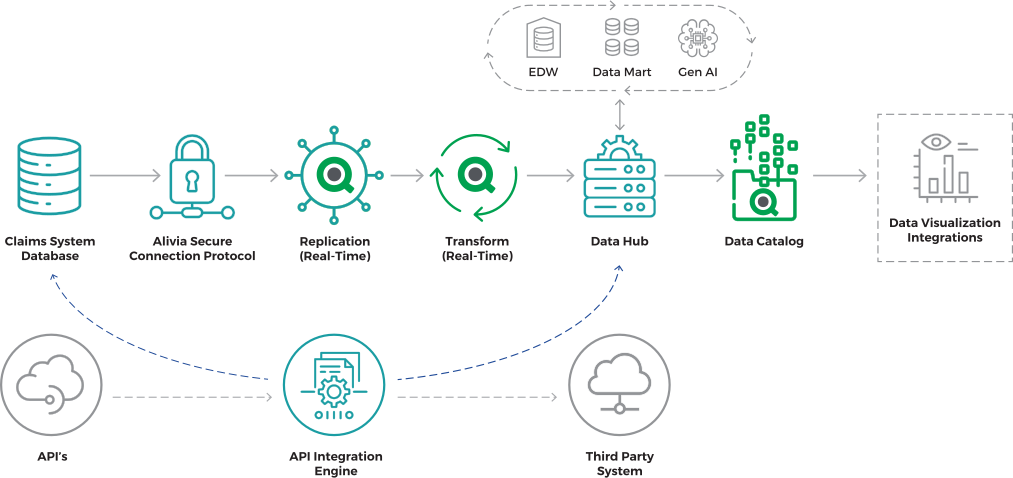
Alivia Analytics’ DataChrome™ solves this challenge. Built as a next-generation healthcare data fabric, DataChrome seamlessly connects, harmonizes, and enriches complex claims data, creating a single source of truth that drives better payment accuracy, fraud detection, and regulatory reporting.

DataChrome™ at a Glance
DataChrome™ isn’t just an integration tool—it’s a data intelligence fabric purpose-built for healthcare claims data:
- Connects claims, provider, pricing, and member data across disparate systems.
- Unifies structured and unstructured datasets into a centralized repository.
- Delivers insights with advanced analytics and AI-ready modeling.
Data Insight
Organizations leveraging modern data fabrics like DataChrome™ have seen up to 60% faster analytics delivery and 30% lower operational costs compared to legacy approaches.

The Power of Partnership
We work with Qlik® to help health plans manage and optimize claims data. By combining Qlik’s advanced integration and visualization capabilities with Alivia’s healthcare expertise, we reduce silos and deliver faster, more actionable insights without locking organizations into a single technology stack.
Why DataChrome™ Matters
Healthcare enterprises managing claims face three persistent challenges:
- Fragmented Data Ecosystems
Multiple claims, provider, and member systems create conflicting datasets. - Slow Time-to-Insight
Traditional integration processes delay reporting and payment accuracy improvements. - Scaling Complexity
As membership, regulatory demands, and vendor ecosystems grow, claims data management must scale seamlessly.
DataChrome™ addresses these issues by creating a unified data foundation that empowers better payment integrity, fraud detection, and regulatory compliance.

Use Case 1: Accelerating Claims Modernization
Challenge
A large regional health plan needed to replace a 30-year-old claims platform while supporting 700,000+ members across five lines of business, including Commercial, Medicare, Medicaid, DSNP, and Exchange products. The core challenge was that claims data was locked away in a mainframe-based platform, limiting its use for analytics and modernization.
Approach:
- DataChrome™ extracted claims data from the mainframe platform, making it analytics-ready.
- Leveraged DataChrome™ to consolidate disparate provider, pricing, claims, and member datasets.
- Integrated seamlessly with HealthEdge’s HealthRules® platform.
- Applied advanced analytics to improve adjudication accuracy.
Results:
- 10X improvement in process clarity and operational efficiency.
- Faster first-pass adjudication rates, reducing manual rework.
- Scalability for five years of projected growth without further system overhauls.
- DataChrome™ can centralize various data sources for all claims systems.
Outcome Highlight
Using DataChrome™, the client reduced claims processing times by 35% while enabling real-time connectivity between members, providers, and payer systems.
Use Case 2: Enabling Data-Driven Decision Making
Challenge
A health plan with approximately 350,000 members and 30,000+ providers needed to modernize multiple legacy systems to support new product offerings. Fragmented data across claims processing, pharmacy, provider directories, and EHR systems limited their ability to make timely, strategic decisions. Much of the claims data was locked away in a mainframe-based platform, restricting its accessibility for analytics.
Approach:
- DataChrome™ extracted the mainframe claims data, transforming it into an analytics-ready format.
- Leveraged DataChrome™ to consolidate all enterprise data into a simplified, unified model.
- Migrated legacy data into a new HealthEdge HealthRules® platform.
- Built an enterprise data warehouse and BI layer to integrate external data and support unified reporting.
Results:
- Reduced the number of data tables from over 1,000 to about 200, improving reporting efficiency.
- Enabled self-service BI so decision-makers could access holistic claims data in near real time.
- Strengthened the ability to support new initiatives and product innovation with reliable, consolidated data.
- DataChrome™ can grab data from any source for any claims system.
Outcome Highlight
Using DataChrome™, the client streamlined reporting and empowered business leaders with trusted, actionable data to guide
key decisions.
The Bigger Picture: Market Impact
$4.5T
in U.S. healthcare spend (2024) — with over $1 trillion lost to waste, fraud, and inefficiency.
85%
of health executives rank claims data integration and interoperability as top priorities for 2025.
Organizations using advanced data fabrics report:
3×
faster fraud detection
2×
improved ROI on payment
integrity programs
40%
reduction in regulatory
reporting errors
The Alivia Advantage
While many integration tools connect systems, Alivia goes further by:
- Combining claims data integration with analytics, AI modeling, and workflow automation.
- Delivering expert consulting alongside technology.
- Offering modular deployment—start with what you need, scale as you grow.
Alivia’s Difference
With DataChrome™, clients gain more than integration—they gain actionable intelligence that drives
better payment accuracy, FWA detection, and regulatory compliance.
Conclusion: Building a Smarter
Healthcare Ecosystem
DataChrome™ powers the next generation of healthcare analytics by eliminating claims data silos, accelerating insights, and enabling organizations to proactively manage costs, compliance, and fraud detection. In an industry where every second and every dollar matters, Alivia equips health plans and agencies to make data-driven decisions faster, smarter, and with greater confidence.
About the Author

Stephen Sideris
SVP, IT Delivery Services
Alivia Analytics
Stephen has over 37 years of healthcare and technology experience in data security, AI / analytics, enterprise software / systems, disaster recovery, and project management. He leads a team of experts that continually improve claims oversight in the Alivia 360™ Platform to ensure payment integrity and combat FWA. Stephen’s leadership also delivers unique and innovative approaches to optimize claims systems, extend the life of legacy systems, convert data, improve EDW, and protect PHI. Prior to joining Alivia, through the acquisition of SourcEdge, he held senior technology roles at companies including Visiant Health and Harvard Pilgrim Health Care. Stephen is a graduate of the University of New Hampshire.
About Alivia Analytics
Alivia Analytics helps health plans and government agencies address complex claims challenges, combining AI-powered technology, expert services, and integrated analytics to reduce improper payments and recover more, faster. Our Alivia 360™ platform uncovers what rules-based systems miss, identifying hidden risks in the “Gray Zone” between error, fraud, waste, and abuse to deliver earlier detection and stronger results across the pre- and post-pay spectrum. Backed by data and IT transformation services, we help clients achieve faster results, greater savings, and reduced provider and member abrasion.
DataChrome™ is a trademark of Alivia Analytics, LLC. All other trademarks, service marks, logos, and brand names referenced herein are the exclusive property of Alivia Analytics, LLC, unless otherwise stated.
Qlik® is a trademark of QlikTech International AB.